
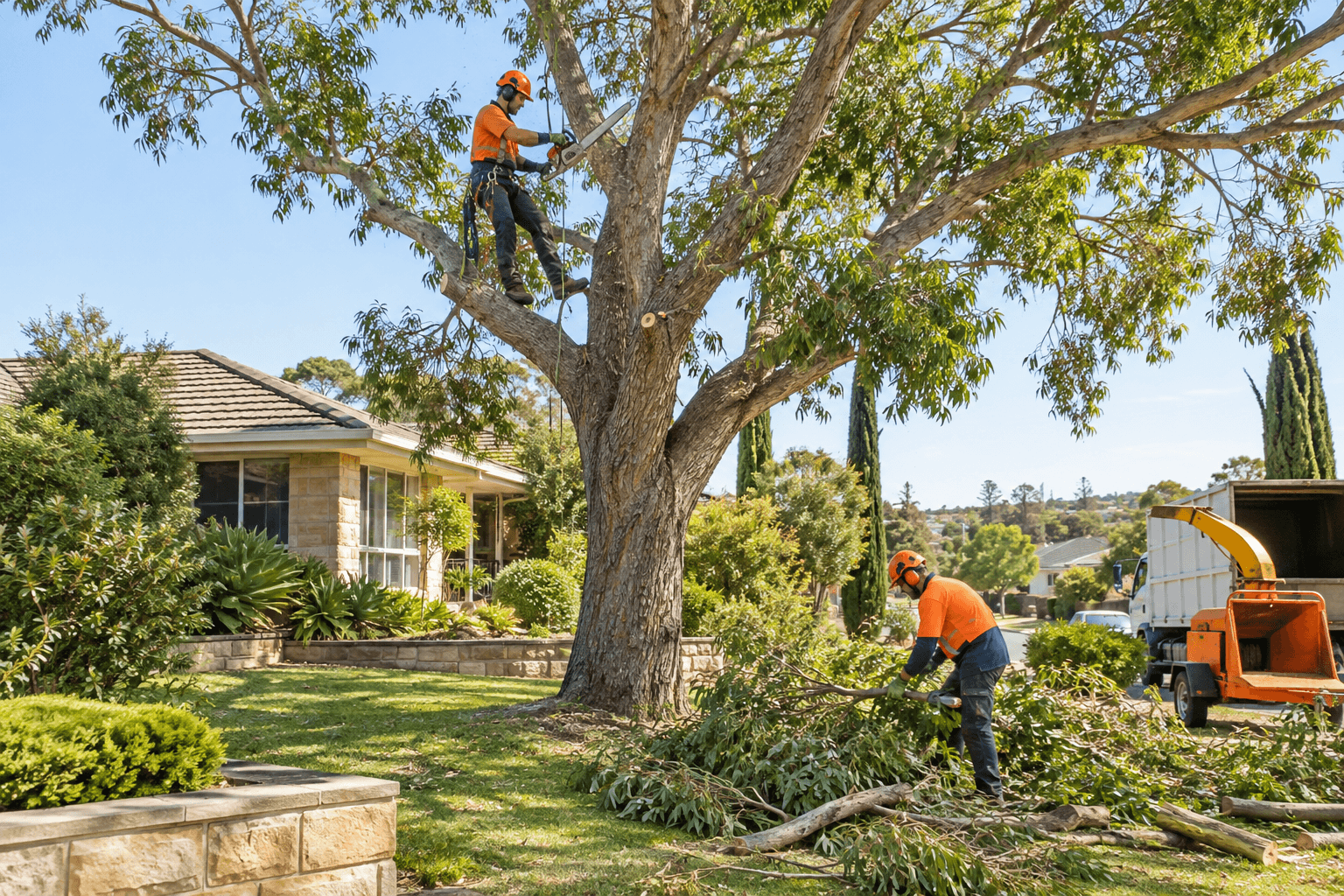
Tree cutting Adelaide is not always about removing an entire tree. Sometimes a few carefully selected cuts can solve a problem, while other trees may need more substantial cutting or complete removal.
If you are searching for tree cutting Adelaide, the first step is understanding what type of work your tree actually needs. Choosing the wrong approach can leave the original problem unresolved or create unnecessary damage to the tree.
At J & B Tree Service, we look at the condition of the tree, its location, surrounding structures and the reason for the work before recommending a solution. Here is how Adelaide homeowners can tell the difference between tree pruning, tree cutting and tree removal.
What Is the Difference Between Tree Cutting, Pruning and Removal?
These terms are often used interchangeably, but they can describe very different types of work.
Tree pruning involves removing selected branches from a tree. It can improve the tree’s structure and remove dead or damaged growth. It can also help manage overgrown branches and maintain clearance around buildings.
Tree cutting can involve larger branches when light pruning is not enough. For example, a large limb may extend towards a roof or driveway. In that situation, reducing the limb may solve the problem without removing the whole tree.
Tree removal means taking the tree down because keeping it in its current location is no longer appropriate or safe.
The right option depends on the tree’s condition. A tree with one damaged branch may only need pruning. However, a severely damaged tree may not be suitable for pruning alone.
When Does an Adelaide Tree Need Pruning?
Pruning is often the first option when the tree is generally healthy but has specific branches causing problems.
You may need pruning when:
- Dead branches are hanging in the canopy
- Broken limbs need to be removed
- Branches are rubbing against each other
- Growth is becoming too dense
- Branches are growing towards a building
- Vegetation is interfering with access areas
- The canopy needs careful structural management
- Branches are creating clearance issues
For example, imagine a large tree growing beside a driveway in an Adelaide suburb. The main trunk and canopy may be healthy, but several branches have grown over the driveway.
Removing the entire tree would be unnecessary if those branches can be safely reduced or removed while maintaining the tree’s overall structure.
This is where careful pruning can make a practical difference to the tree while addressing the branches causing the problem.
Good pruning is not simply about cutting branches wherever they look inconvenient. Poorly selected cuts can affect the tree’s structure and may create additional problems later.
When Is Tree Cutting Adelaide the Better Option?
There are situations where a tree needs more than routine pruning but does not necessarily need to be removed.
This can happen when a larger limb has become problematic because of its position, size or condition.
For example, you might have:
- A heavy branch extending towards a roof
- A large limb blocking vehicle access
- Branches growing into an area where they could cause damage
- A section of canopy that has become excessively heavy
- A damaged section following strong winds
- Large growth interfering with nearby structures
In these situations, targeted cutting may solve the problem without removing the entire tree.
The important part is understanding where and how much to cut.
Removing too much growth can change the tree’s structure and appearance. It may also affect the balance of the remaining canopy. Therefore, larger cuts should be planned carefully.
For homeowners looking for tree cutting Adelaide, the useful question is therefore not simply, “How much can be cut?”
It is:
“What needs to be removed to solve the problem while keeping the remaining tree as stable and healthy as reasonably possible?”
That is something we assess on site rather than deciding from a photograph alone.
When Is Tree Removal Actually Necessary?
Tree removal becomes a consideration when the problem cannot be reasonably solved through pruning or cutting.
Some situations that may require closer assessment include:
- Severe structural damage
- A tree that has become unstable
- Extensive decay or deterioration
- Significant storm damage
- A tree that is seriously compromised and presents a safety concern
- Major conflicts with structures or property that cannot be resolved through suitable pruning
- A tree that is dead and no longer able to recover
The condition of the tree matters, but so does its surroundings.
A tree in an open backyard may present very different risks from a similar tree growing beside a house, driveway, retaining wall or service area.
This is why we do not recommend removal simply because a tree is large, old or inconvenient.
If removal is genuinely the appropriate solution, the work should also be planned around access, nearby structures, powerlines, surrounding vegetation and the safest way to dismantle the tree.
If removal is genuinely the appropriate solution, you can learn more about how we approach tree removal and site safety before arranging the work.
What About Tree Lopping?
Tree lopping is another term homeowners commonly hear when looking for a solution to an overgrown tree.
The problem is that simply removing large sections of a canopy is not always the same as carrying out thoughtful, targeted tree work.
If a tree has grown too close to a house, for example, cutting large sections off the top may appear to solve the problem temporarily. But if the underlying structure and future growth are not considered, the tree may quickly become difficult to manage again.
The better approach is to assess why the branches are causing a problem and determine what type of work is appropriate.
That could mean selective pruning, reducing specific branches, more substantial cutting or, where necessary, complete removal.
A Realistic Adelaide Property Example
Consider a homeowner who has a mature tree growing close to the side of their house.
Over time, several branches have extended towards the roof. During windy weather, the branches move against the roof area, and the homeowner becomes concerned about potential damage.
Their first thought might be:
“The whole tree needs to come down.”
But that is not necessarily the case.
During an assessment, a tree professional may find that the trunk and main structure are in reasonable condition and that the issue is concentrated around several branches.
If those branches can be safely managed through appropriate pruning or cutting, the homeowner may be able to address the immediate concern without removing the entire tree.
Now consider a different situation.
Some trees have serious structural problems. If the tree could affect a house, driveway or other important area, cutting a few branches may not solve the problem. In that situation, the whole tree may need a closer assessment.
The solution needs to match the actual problem.
What We Look At Before Recommending Tree Work
Before deciding between pruning, cutting and removal, there are several things worth considering.
1. The tree’s overall condition
We look at the trunk, major branches, canopy and visible signs of damage or deterioration.
2. Where the tree is located
A tree beside a house requires a different approach from one standing in an open section of a large property.
3. The reason for the work
Are you concerned about dead branches, excessive growth, property clearance, storm damage, access or the tree’s overall condition?
The answer helps determine what type of work is actually relevant.
4. Nearby structures and obstacles
Roofs, fences, sheds, driveways, retaining walls and other structures can affect how work needs to be carried out.
5. Access to the tree
Limited access can affect the equipment and work method. This becomes especially important when large branches need to be lowered safely.
6. Council requirements
Some trees may be protected or subject to local rules. Before arranging removal, it is worth checking the local requirements for removing a tree from your property.
For Adelaide homeowners, this is particularly worth checking before assuming that a tree can simply be removed.
Can Tree Cutting Solve a Problem Without Removing the Tree?
In many situations, yes but it depends entirely on the tree and the problem.
For example, if only a few branches are causing clearance issues, targeted cutting may address the problem while leaving the main tree in place.
However, cutting should not be viewed as a way to avoid removal at all costs.
However, cutting is not always enough. Serious structural problems or extensive deterioration may require another solution. In some cases, cutting may only delay the need for removal.
The goal should be to choose the appropriate level of work, rather than automatically choosing the smallest or largest option.
Which Tree Service Does Your Property Need?
A simple way to think about it is:
Pruning:
Use pruning when selected branches need to be removed or managed.
Tree cutting:
Larger branches may need to be reduced when they create a specific property problem.
Tree removal:
Removal may be necessary when the tree cannot be safely or reasonably retained.
There can also be overlap between these services. A single job may involve removing damaged branches first and then determining whether further work is necessary.
If you are unsure, don’t start cutting large branches yourself just to see what happens. Once a substantial branch is removed, the situation cannot simply be reversed.
A site assessment gives you a much clearer idea of what the tree actually needs.
Choosing the Right Approach for Your Adelaide Property
Tree work should solve a problem without creating another one.
If your tree is overgrown or has a few problem branches, pruning may be enough. Larger branches may require more substantial cutting. However, a severely compromised tree may need to be removed.
At J & B Tree Service, we can assess the tree and explain the practical options available for your property.
If you are unsure whether tree cutting Adelaide is the right option for your property, contact our team to discuss the situation and arrange an assessment.
FAQs
Is tree cutting the same as tree pruning?
Not always. Pruning generally focuses on selective branch removal for tree health, structure and maintenance, while tree cutting can refer to more substantial branch or section removal depending on the situation.
Does an overgrown tree always need to be removed?
No. An overgrown tree may be manageable through appropriate pruning or other targeted tree work. Its condition, structure and location should be assessed before deciding on removal.
When should a tree be completely removed?
Removal may be considered when a tree is dead, seriously damaged, structurally compromised or presents a problem that cannot reasonably be addressed through pruning or cutting.
Can I cut large tree branches myself?
Large branches can be difficult to control and may fall unpredictably. Cutting near buildings, powerlines or other structures can also increase the risk, so substantial tree work is better assessed and handled by appropriately equipped professionals.
How do I know if my tree needs pruning or cutting?
Look at the specific problem. A small number of unwanted, dead or poorly positioned branches may call for pruning, while larger limbs creating clearance or structural problems may require more substantial cutting.
Can tree cutting damage a healthy tree?
It can if too much growth is removed or cuts are made incorrectly. The amount and location of cuts should take the tree’s structure and future growth into account.
Do I need council approval before removing a tree in Adelaide?
It depends on the tree and the applicable local rules. Homeowners should check the relevant council or South Australian planning requirements before arranging removal.
What happens after a tree is removed?
Depending on the service requested, the remaining stump and wood may need to be dealt with separately. If you want the area completely cleared, discuss stump removal and cleanup when arranging the work.