
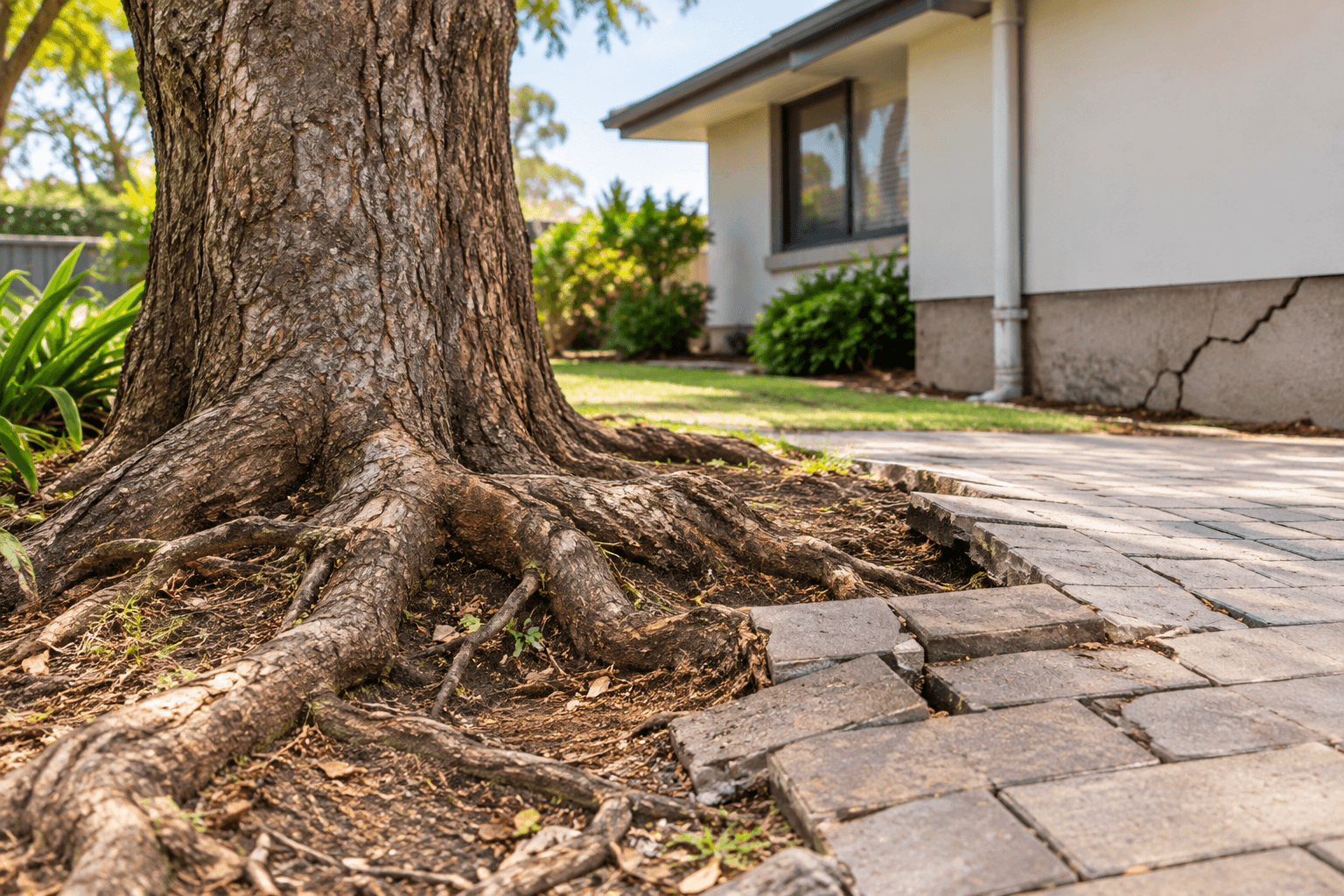
A tree can look perfectly healthy above the ground while its roots are causing problems underneath. If you’ve noticed lifted paving, exposed roots or repeated drainage issues, our team can help you work out what’s actually happening before you decide on tree removal in Adelaide.
Can Tree Roots Really Damage Your Property?
Yes, tree roots can contribute to property problems, but it’s not always as simple as blaming the nearest tree.
For example, a crack in paving beside a mature tree may be partly related to roots, but soil movement, the condition of the paving and other factors can also be involved. The same applies to cracks around a house. A crack near a tree doesn’t automatically prove that its roots caused structural damage.
The City of Unley notes that roots generally enter pipes through existing damage or leaks rather than simply breaking through sound pipes. It also points out that soil conditions and changes in soil moisture can contribute to movement around buildings and paving.
That’s why we prefer to understand the problem first rather than immediately recommend removing a tree.
What Problems Can Tree Roots Cause?
Tree roots naturally grow in search of water, nutrients and space. When a mature tree is growing close to a driveway, pathway, drainage pipe or building, those roots can sometimes create problems.
If a tree eventually needs to be removed, dealing with the remaining stump is another important step. Stump removal in Adelaide can help clear the remaining tree material and make the area safer and easier to use.
Lifted Paving and Driveways
One of the easiest problems to spot is uneven paving.
Surface roots can sometimes grow beneath paths and pavers, contributing to raised or uneven sections. If you’ve noticed a part of your driveway slowly lifting beside a mature tree, it’s worth getting the area checked before cutting any roots.
A root that looks relatively small above the ground can be connected to a much larger root system.
Blocked Drains
Repeated drain blockages can also raise concerns when mature trees are nearby.
Tree roots can enter existing cracks, damaged joints or leaking sections of underground pipes where moisture is available. If you’ve already had the same drain cleared several times, it’s worth asking a qualified plumber to inspect the pipe.
Removing the nearby tree without fixing a damaged pipe may not solve the problem.
Retaining Wall Problems
A mature tree growing close to a retaining wall can make an already difficult situation more complicated.
If you notice movement, cracking or other changes around the wall, don’t automatically assume the tree is responsible. Soil pressure, drainage, ground movement, the condition of the wall and nearby roots may all need to be considered.
Concerns Around Foundations
This is usually where homeowners become most concerned.
Can roots damage your house?
The honest answer is that it depends on the circumstances.
Tree roots can interact with soil moisture and may contribute to problems in some situations. However, foundation movement can have several causes, and a crack near a tree does not automatically mean the roots caused it.
If you’re seeing significant structural cracking or movement, we recommend having the building issue properly assessed as well as getting the nearby tree looked at.
Signs Tree Roots May Be Causing a Problem
There isn’t one particular sign that proves a tree is causing property damage.
Instead, look for changes that have appeared over time.
You might notice:
- Pavers becoming uneven near a mature tree
- A driveway starting to lift
- Roots becoming exposed above the soil
- Repeated drain blockages
- Changes around a retaining wall
- Soil lifting around the base of the tree
- A tree becoming less stable
- Roots growing into an area where construction is planned
- New problems appearing close to a large established tree
One sign on its own doesn’t necessarily mean the tree needs to be removed.
The more useful question is:
What’s causing the problem, and can it be safely managed?
Should You Cut Tree Roots Yourself?
We wouldn’t recommend it.
If a root is lifting a paver, cutting it can seem like the quickest solution. The problem is that you can’t always see how important that root is to the tree’s stability.
Removing larger roots can affect the health and stability of a tree. The risk is even greater when the tree is large, mature, leaning or growing close to a building.
Before cutting a significant root, get professional advice.
Does Root Damage Mean the Tree Needs to Be Removed?
Not necessarily.
This is something we think homeowners should know before spending money on removal.
A healthy tree contributing to a minor paving problem may not need to come down. Depending on the circumstances, pruning, property repairs or another form of tree management may be more suitable.
On the other hand, if the tree is unstable, seriously damaged or creating a genuine safety risk, professional tree removal may be the better option.
Our approach is to look at the tree and surrounding area before recommending the most suitable solution.
In some situations, tree pruning in Adelaide may be a safer and more practical option than removing a healthy tree.
A Simple Example From an Adelaide Property
Imagine you have a large tree growing beside your paved driveway.
Over time, several pavers begin to lift and you can see roots underneath them.
Your first thought might be:
“The roots are damaging my driveway, so the tree needs to go.”
But there is another question worth asking first:
Are the roots actually the main cause, and can the problem be managed without removing the tree?
If the tree is healthy and stable, removal may not be necessary.
Now imagine the same tree is also leaning, has significant structural defects and is positioned where a failure could damage your home or another structure.
That’s a very different situation.
In that case, professional tree removal may be worth considering.
The difference isn’t simply that roots are visible. It’s the condition of the tree, the surrounding property and the level of risk.
What Should You Do If Tree Roots Are Causing Problems?
Don’t start by cutting the roots.
Instead, we recommend taking a few simple steps.
1. Take Photos
Photograph the affected roots, paving, driveway, cracks or other areas.
If the problem changes over time, these photos can also give you a useful record.
2. Don’t Cut Major Roots
Leave larger roots alone until you know whether they are important to the tree’s stability.
3. Work Out What Is Actually Wrong
Is the main problem:
- A blocked drain?
- Lifted paving?
- A retaining wall?
- A potentially unstable tree?
- A planned construction project?
- Exposed roots?
Identifying the problem helps determine who should investigate it.
4. Check Underground Services
If digging or excavation is planned around a tree, make sure underground pipes and cables are identified first.
5. Get the Right Professional Advice
A plumber can investigate a drainage or sewer problem.
A structural professional may be needed if there are serious concerns about building movement.
A tree professional can assess the tree itself and advise whether pruning, management or removal may be appropriate.
Sometimes getting the right answer means involving more than one professional.
What About Tree Roots Near a New Building or Extension?
This is something worth thinking about before construction begins.
If you’re planning an extension, new driveway, paving or excavation close to a mature tree, don’t wait until the machinery arrives before considering the tree.
Tree Protection Zones and Structural Root Zones can be important during development around established trees. Getting appropriate advice early can help prevent unnecessary damage to the tree and avoid problems during construction.
When Might Tree Removal Be the Right Choice?
There are situations where keeping a tree simply isn’t practical or safe.
Removal may be considered when a tree:
- Has serious structural defects
- Has suffered major storm damage
- Is unstable
- Has significant decay
- Has severe root-related stability concerns
- Is growing in an unsuitable location
- Presents an unacceptable risk to people or property
But an inconvenient tree isn’t automatically a dangerous tree.
Sometimes pruning or another management option can solve the problem without removing it.
If you’re unsure, an assessment can help you make the decision based on the actual condition of the tree.
Internal link: [tree removal Adelaide] → Link to your main Tree Removal Adelaide service page.
How We Assess a Tree at J & B Tree Service
When someone contacts us about a tree close to their home, we don’t simply look at the visible roots and say, “Remove it.”
We look at the tree as a whole.
Our assessment considers things such as the tree’s condition, trunk and branches, stability, visible root issues, nearby structures, access to the property and why you’re concerned about the tree in the first place.
J & B Tree Service has more than 35 years of local experience providing tree services across Adelaide and surrounding areas.
We can help with:
- Tree removal
- Tree pruning
- Tree cutting
- Stump removal
- Palm tree removal
Don’t Assume the Tree Is Always the Problem
This is probably the most useful thing to remember.
A blocked drain doesn’t automatically mean you need tree removal.
A cracked path doesn’t automatically mean the roots are responsible.
And a crack in a wall doesn’t automatically mean a nearby tree has damaged your foundation.
Several things can happen at the same time. That’s why we believe it’s better to identify the cause before making a permanent decision about the tree.
What About Council Approval?
If your assessment shows that tree removal may be necessary, don’t assume you can simply cut the tree down.
South Australian planning requirements can apply to regulated and significant trees, depending on the tree and circumstances.
Before arranging removal, check whether the tree is protected and whether approval or an exemption applies.
Final Thoughts
Tree roots can contribute to problems around Adelaide properties, but the answer isn’t always tree removal.
If you’ve noticed lifted paving, exposed roots, repeated drain problems or concerns about a tree growing close to your home, start by finding out what’s actually happening.
If the tree does need attention, our team can help you understand whether pruning, removal or another option makes sense for your property.
Concerned About a Tree on Your Adelaide Property?
Don’t guess and don’t start cutting major roots yourself.
Contact J & B Tree Service and let our team assess the situation and explain your options.
Phone: 0414 223 870
Email: brian.c63@outlook.com
We provide professional tree services across Adelaide and surrounding areas.
Frequently Asked Questions
1. Can tree roots damage a house in Adelaide?
Tree roots can contribute to some property problems, but a crack near a tree doesn’t automatically mean the roots caused it. Soil conditions, moisture changes and existing structural issues can also be involved.
2. Can tree roots damage pipes?
Yes, roots can enter damaged or leaking pipes through cracks and joints. If the same drain keeps blocking, have the pipe inspected before deciding that the nearby tree needs to be removed.
3. Can tree roots lift paving?
Surface roots can contribute to lifted or uneven paving. However, the paving, soil and surrounding conditions should also be considered before deciding that the tree is responsible.
4. Should I cut tree roots near my house?
We don’t recommend cutting large roots yourself. Some roots contribute to a tree’s stability, and cutting them without proper assessment can create a bigger problem.
5. Does tree root damage mean I need tree removal?
No. Depending on the situation, pruning, property repairs or other management options may be possible. Removal becomes more relevant when the tree presents a significant safety risk or cannot reasonably be retained.
6. What should I do if tree roots are lifting my driveway?
Don’t immediately cut the roots or remove the tree. Have the area assessed first so you can understand whether the roots, paving, soil conditions or another factor is responsible.
7. Can tree roots block drains?
Yes. Roots can enter damaged sections of underground pipes and contribute to recurring blockages. A plumber can inspect the pipe to determine what is happening.
8. How do I know if a tree near my house is dangerous?
Look for changes such as significant leaning, major dead branches, decay, damaged roots or signs of instability. If you’re concerned, keep people away from the area and arrange a professional assessment.
9. Do I need council approval to remove a tree in Adelaide?
It depends on the tree and the applicable South Australian planning requirements. Before arranging removal, check whether the tree is regulated or significant and whether approval or an exemption applies.